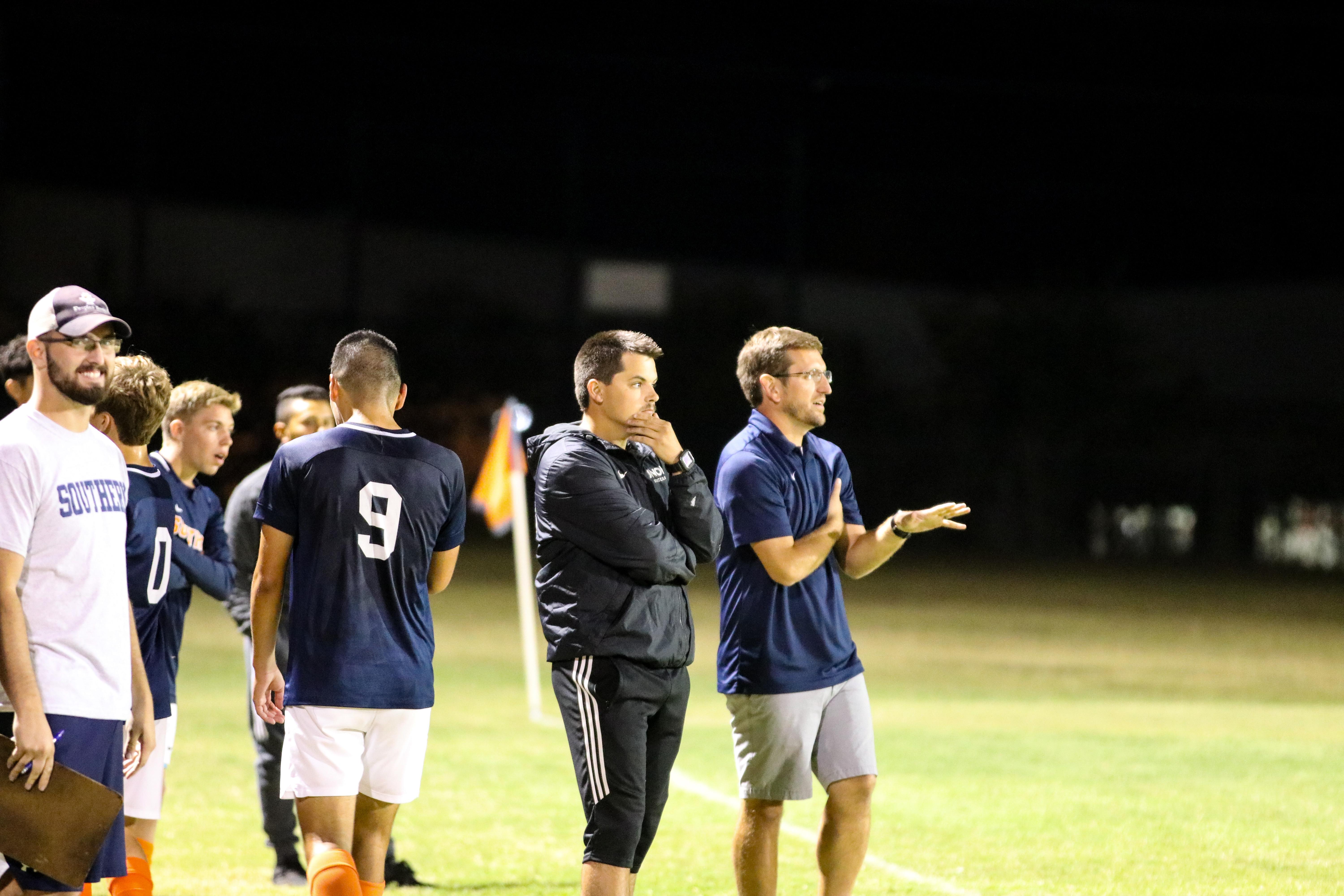
Moving to Central Kentucky to coach meant much tougher competition. Three games into my first season at my new school and we were 1-2. I had reached the other side of the Dunning-Kruger peak.
What I had gotten really good at at my old school was player growth through technical ability. I was going to really have to grow my tactical knowledge. Other coaches here had also played college or even semi-pro soccer. The players at our schools were the first of the generation of their parents who had always had soccer or they had played themselves. It was just a whole other level of understanding. The early missteps my first years were simply underestimating or not understanding enough to put our team in a good position to win games, or to grow during the season.
At my first school, the intensity and physical load level varied wildly, and we might only see three or four games in a season that really pushed the team or challenged them. This wasn't through intentional scheduling; it just took at least an hour from our school in eastern Kentucky to another that had any history of soccer. Most of the programs in our area were five to ten years behind ours and it showed. That allowed us to have much tougher practices and really push the players on those days.
At my new school, that was not the case. A typical week would see us play at least one team at our level and likely one team that could make a run for their region's championship. Playing the teams that were perennial favorites in our region was a step up from that level even.
It became evident very quickly how exhausted my players were on practice days once we started playing in the regular season. Games were just taking too much out of us for me to try and instill any major tactical training during the week. Wednesday practices became useless. Friday practices became worse. I was trying to force in heavy tactical principles sandwiched between grueling games - concepts like building out through a press, how to attack the areas in the goal box where passes can translate to assists. I was keeping the whole team on one page with the limited practice time it felt like we had so we were at our best each game. Our record didn't show it, but we were struggling to get better.
It is a testament to the skill and resilience of the players I had, especially the senior class, that we kept getting good results one after another that year. We capped off the first season with a level of success that the program hadn't had in a long while, and all got some well-deserved rest in the offseason.
Year two started just like year one, minus the senior class that could carry us. Good preseason, but once games started we hit a wall. We were 1-4-1. We were losing games we shouldn't have. I remember one day having a conversation with my captain through that stretch and he had said "Coach, we're too tired."
I had to rethink my practices, especially the intensity and what I was trying to teach tactically. We were still a good technical team, but we were losing the tactical battles - the close games decided on player and player-group decisions based on roles or positioning.
Early September of 2019 I remember looking at the calendar ahead. We had several three-game weeks. For better or worse, that's what the high school game is in our country. I realized we had as many games as practices left at that point in the season and I made the decision: any game not for postseason seeding was going to be our tactical session.
Practices would serve as technical work, recovery, and mostly small-group work that would fit in our bigger playing philosophy model. Think center back, left back, and defensive mid working together, or center attacking mid, winger, and forward rotating and pressing together. This meant higher intensity for fewer minutes in a practice day - maybe 15- to 30-minute spans where we really focused and got the best out of our players. Practice times dropped as well. In a two-hour practice, we might spend an hour and a half playing, using ten minutes for team building, recovery, and even field maintenance and care.
We would, to the best of our ability, use the games themselves as the teacher of the tactics. All of our feedback during the game was focused on the team, the big picture. We would save the small stuff for film review and practice days in between. This meant larger full-team concepts were only tested early in the season and refined as we went further into the year.
I spent more time watching game film in those years than live sports or any other TV, I'm sure. When we got to a film session, I would highlight three or four key moments that linked to the playing style we were trying to incorporate. Those would become the principles we worked into the practices. Any time I could, I would spend ten to fifteen minutes with players individually looking at small technical things, but overall the team film sessions were for just that: a mirror to see where we could improve and how we were improving together in the games.
There would be games that on paper we should win, but because it was early in August we might drop one to a team of lesser skill simply because we wanted to work on a new way to distribute the ball from our center backs to our wide players. We lived with those results. The goal was always to shore up the defensive side by mid-September, then shift toward full-team offensive principles later. This also worked into making the small-group work at practice more intentional. We might split into two or three groupings of players to work on these concepts on a Monday practice. It would finish at max seven-versus-seven to goal. Then we'd use the full game on Tuesday to work on merging ideas together for the system.
Great coaches do this already. They say we are building to be a championship team, or they look at the season as a whole and build for the postseason. That wasn't new to me. What was new, or at least the gamble in my mind, was coaching games like they were practices while still trying to thread the needle and be competitive in them.
This went against what coaching courses and literature I had come across said. Practice was where you got better; games were just for proving the practice was working, or for getting results. Sure, everyone knew you could get better through playing - the game is the best teacher, of course. But how we implemented it was very intentional.
We started consistently playing well in late September and early October. We played our best soccer every year the week of the district tournament.
We were a 5A program in a region full of 6A schools that regularly competed for state titles. We had maybe nine club kids in a good year to their thirty. We weren't beating those programs, but we were competing with them. And by mid-September through October we were beating the teams in our district and the programs that looked like us on paper consistently.
After that 1-4-1 start in 2019, we went on to win the district championship. The first time our team had done that in almost twenty years. Over the next five seasons we went on to win three more, totaling five out of the seven in my time as head coach. Every year the same pattern. I knew the approach was working. I could see it every October.